When Your Kitchen Feels Like a Stranger: Rediscovering Home Cooking After Life Abroad
I came home from six weeks abroad with a suitcase full of dirty laundry, a phone camera roll I'll never fully organize, and a deeply inconvenient new opinion about tomatoes. Specifically: that the ones at my local grocery store are kind of a lie.
This is not a complaint. Okay, it's a little bit of a complaint. But mostly it's an observation about what extended travel does to you in ways nobody warns you about. Everyone talks about missing home cooking while you're away. Nobody talks about coming home and feeling like your own kitchen is slightly hostile territory.
The Palate Problem Nobody Mentions
When you spend significant time eating food made with local ingredients, prepared with regional techniques, and served in the context of actual culture — not just cuisine — your baseline shifts. It happens quietly. You don't notice it until you're standing in your kitchen on a Tuesday night trying to make pasta and thinking, this is fine, but it's not...
And you can't always finish that sentence. It's not that the food is bad. It's that your reference point has moved.
Flavors you used to find exciting now taste a little flat. Textures you never questioned suddenly seem off. You reach for a spice and realize the version you bought three years ago from a big-box store is a pale imitation of what you shook over your eggs at a guesthouse in Oaxaca. This is the reverse culture shock of the kitchen, and it's genuinely disorienting.
Why This Happens (And Why It's Actually Good News)
Your palate is not broken. It's educated. There's a real difference.
Extended travel — especially when you eat like a local rather than a tourist — exposes you to ingredients at their peak, cooking methods that prioritize flavor over convenience, and a relationship with food that's less transactional than what most of us grew up with in the US. We're conditioned to think of cooking as a task. In a lot of the places I've traveled, it's more like a conversation.
So when you come home and your old recipes feel hollow, that's not a failure. That's your expanded sense of possibility bumping up against the limits of your current pantry. The question is what you do with that tension.
The Ingredient Gap Is Real, But Workable
Let's be practical for a second. You cannot always source the exact produce, proteins, or condiments you fell in love with abroad. Some of that is geography. Some of it is season. Some of it is the fact that a specific cheese only exists in a 40-mile radius in France and that's just the way it is.
But here's what you can do:
Find your local ethnic grocery stores. Seriously, this is the single biggest upgrade to your home cooking life after travel. Most mid-size American cities have Korean markets, Indian grocery stores, Mexican tiendas, or Middle Eastern shops that carry ingredients you'd otherwise never find at a standard supermarket. The prices are often better, too.
Shop seasonally, even if it's annoying. One of the biggest reasons food tastes better in other countries is that it's often just... in season. We've gotten so used to year-round access to everything that we forget tomatoes are actually a summer fruit. Leaning into what's actually growing right now in your region makes a huge difference.
Upgrade your pantry staples. You don't need to spend a fortune, but swapping out a few key items — better olive oil, whole spices you toast and grind yourself, good vinegar — can close a surprising amount of the flavor gap.
Letting Go of the Exact Replica
Here's the part that took me the longest to accept: you will probably never perfectly recreate that dish. The one from the little place down the alley. The one you still think about at random moments. And chasing a perfect replica is kind of missing the point.
What travel teaches you about food isn't a set of recipes. It's a way of approaching the kitchen — with more curiosity, less rigidity, and a willingness to taste as you go rather than following instructions like a legal document. The goal of cooking at home after travel shouldn't be to recreate. It should be to translate.
Take the spirit of what you learned and apply it to what's available to you. Love the simplicity of Italian cooking? Apply that restraint to whatever's in your fridge. Obsessed with the layered spicing of South Asian food? Start building that knowledge with what you can find locally and go from there.
The Kitchen as a Living Travel Journal
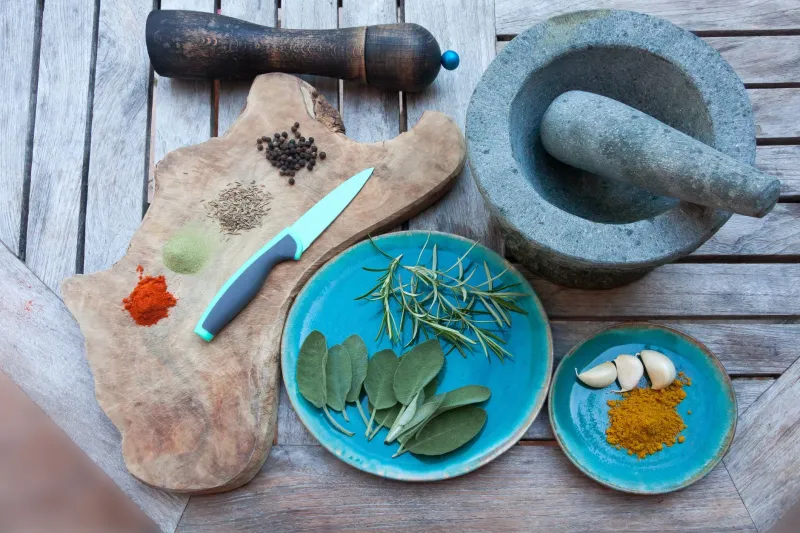
My kitchen has become a pretty honest record of where I've been. There's a jar of za'atar I bought because of a trip that changed how I think about breakfast. There's a well-used mortar and pestle that came directly from realizing I'd been cheating myself with pre-ground spices for years. There's a handwritten note on my fridge that just says less is more — a reminder I gave myself after watching someone make an extraordinary meal from four ingredients.
Coming home doesn't have to mean reverting. Your kitchen can hold all of that accumulated experience if you let it. The disorientation you feel when you first get back is just the friction of integration — your old life and your new perspective figuring out how to share the same counter space.
Give it time. Cook through it. And maybe go find a better tomato.